Strong Principles Episode 4: Metabolism & Mind Games: Understanding Vacation Weight
Strong Principles
| Rob DelaCruz, Larry Medina, Pete Miller | Rating 0 (0) (0) |
| Launched: Aug 04, 2025 | |
| trips91@gmail.com | Season: 1 Episode: 4 |
Intro
-
Rob, Larry, and Pete kick off a new episode focusing on nutrition.
-
The discussion begins with their experiences of going on vacation and eating differently than usual.
Surprising Weight Changes
-
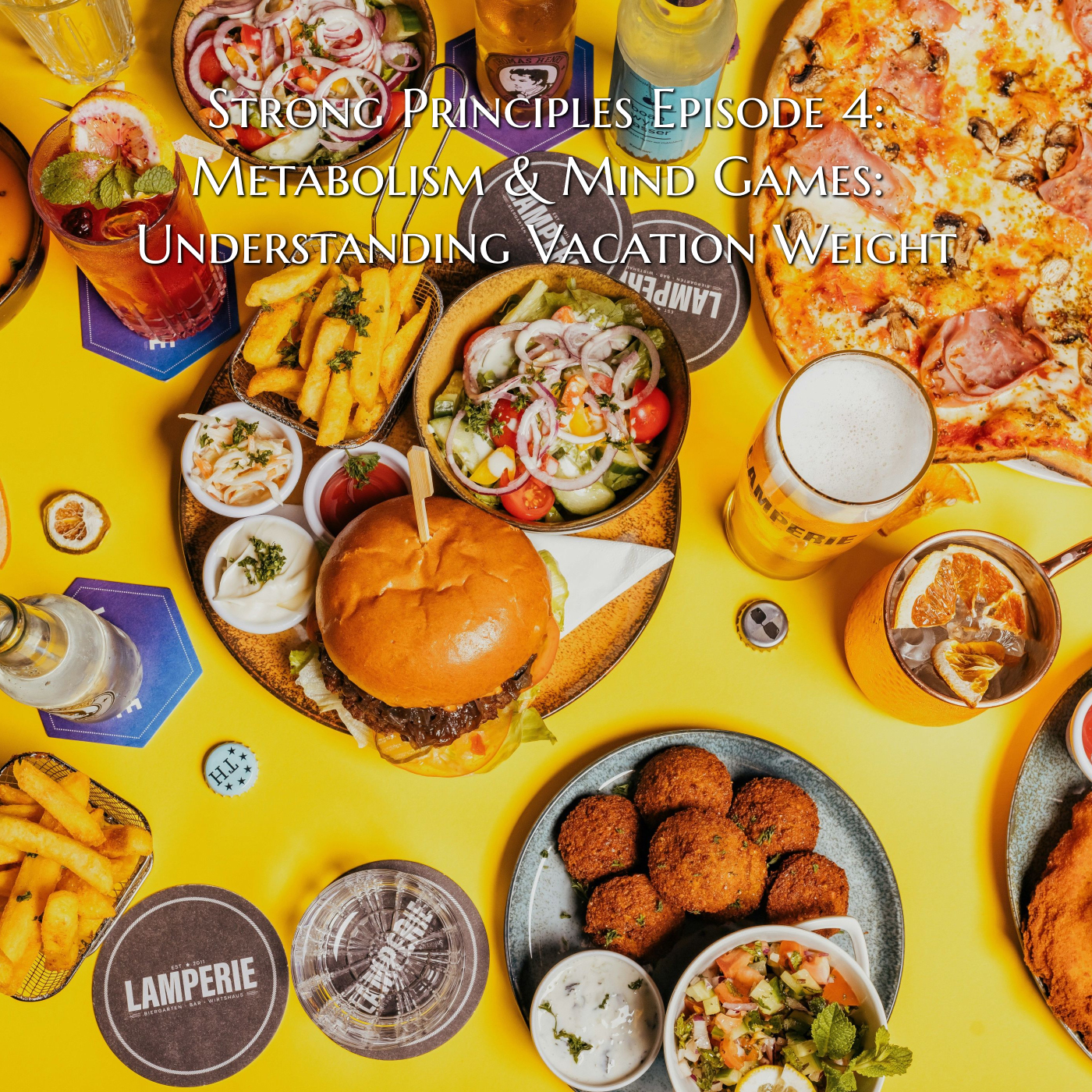
Rob brings up that when people go on vacation, they often eat and drink more, particularly "bad" foods like burgers, pizza, and beer. The expectation is to gain weight.
-
Larry and Pete both share that after their respective vacations, they were shocked to find they had actually lost weight (Larry lost 2 pounds and Pete lost 2 pounds).
-
However, the confusion deepens as they describe gaining weight after they returned home and resumed their normal, healthy eating and workout routines.
The "Novelty" Effect and Metabolism
-
Rob explains that the human metabolism is incredibly complex and varies for everyone.
-
He introduces the concept of "novelty," where the body has a rapid, sometimes unexpected, reaction to a change in routine.
-
The hosts theorize that going from a clean diet to one high in carbohydrates and sugar might have acted as a shock to their systems, causing their bodies to use the new energy quickly.
-
This "novelty" explains why they initially lost weight, as their bodies responded to the change in an unusual way.
-
However, this effect is short-lived.
The Rebound Effect and Confusion
-
Larry and Pete describe the frustration of returning home, eating "clean," and seeing their weight go up.
-
Rob clarifies that this is the rebound effect, where the full impact of vacation eating doesn't show up immediately but can have a "two-week carryover."
-
This period can also involve inflammation and water retention, contributing to the frustrating weight gain.
-
The hosts discuss how stress from traveling and doing different activities can also burn more energy.
The Problem with Fad Diets and Processed Foods
-
The conversation transitions to fad diets like Keto, Carnivore, and "75 Hard."
-
Larry argues that while these diets can produce results, they are often not sustainable in the long term, making them a "fad."
-
Rob agrees, emphasizing the importance of a sustainable approach. He suggests starting with a simple focus on protein intake (grams equal to goal body weight) and consuming whole foods over processed ones.
-
The hosts discuss the key difference between whole foods and processed foods. The number of ingredients on a label is a good indicator, with highly processed foods often having five or more ingredients, many of which are unrecognizable.
-
Rob uses the examples of fresh-squeezed juice versus bottled juice and homemade bread versus store-bought Wonder Bread to illustrate how convenience often means added sugars, preservatives, and a lack of natural fiber and nutrients.
-
The episode concludes with a reminder that no amount of ultra-processed food or alcohol is considered "healthy," though occasional indulgence is not a problem. The key is to be mindful of what we're consuming and to focus on simple, sustainable habits.
SUBSCRIBE

Episode Chapters
Intro
-
Rob, Larry, and Pete kick off a new episode focusing on nutrition.
-
The discussion begins with their experiences of going on vacation and eating differently than usual.
Surprising Weight Changes
-
Rob brings up that when people go on vacation, they often eat and drink more, particularly "bad" foods like burgers, pizza, and beer. The expectation is to gain weight.
-
Larry and Pete both share that after their respective vacations, they were shocked to find they had actually lost weight (Larry lost 2 pounds and Pete lost 2 pounds).
-
However, the confusion deepens as they describe gaining weight after they returned home and resumed their normal, healthy eating and workout routines.
The "Novelty" Effect and Metabolism
-
Rob explains that the human metabolism is incredibly complex and varies for everyone.
-
He introduces the concept of "novelty," where the body has a rapid, sometimes unexpected, reaction to a change in routine.
-
The hosts theorize that going from a clean diet to one high in carbohydrates and sugar might have acted as a shock to their systems, causing their bodies to use the new energy quickly.
-
This "novelty" explains why they initially lost weight, as their bodies responded to the change in an unusual way.
-
However, this effect is short-lived.
The Rebound Effect and Confusion
-
Larry and Pete describe the frustration of returning home, eating "clean," and seeing their weight go up.
-
Rob clarifies that this is the rebound effect, where the full impact of vacation eating doesn't show up immediately but can have a "two-week carryover."
-
This period can also involve inflammation and water retention, contributing to the frustrating weight gain.
-
The hosts discuss how stress from traveling and doing different activities can also burn more energy.
The Problem with Fad Diets and Processed Foods
-
The conversation transitions to fad diets like Keto, Carnivore, and "75 Hard."
-
Larry argues that while these diets can produce results, they are often not sustainable in the long term, making them a "fad."
-
Rob agrees, emphasizing the importance of a sustainable approach. He suggests starting with a simple focus on protein intake (grams equal to goal body weight) and consuming whole foods over processed ones.
-
The hosts discuss the key difference between whole foods and processed foods. The number of ingredients on a label is a good indicator, with highly processed foods often having five or more ingredients, many of which are unrecognizable.
-
Rob uses the examples of fresh-squeezed juice versus bottled juice and homemade bread versus store-bought Wonder Bread to illustrate how convenience often means added sugars, preservatives, and a lack of natural fiber and nutrients.
-
The episode concludes with a reminder that no amount of ultra-processed food or alcohol is considered "healthy," though occasional indulgence is not a problem. The key is to be mindful of what we're consuming and to focus on simple, sustainable habits.
After going on vacation and enjoying all the burgers, pizza, and drinks, Rob, Larry, and Pete are shocked to find they've lost weight. But the confusion deepens when they return home, start eating clean again, and suddenly gain weight. The crew dives into the science behind this post-vacation weight paradox, discussing the "novelty effect" on your metabolism, the "two-week carryover" from vacation eating, and the pitfalls of fad diets. They share simple, sustainable tips for staying on track and avoiding the frustration of unexpected weight changes.
Rob (00:00)
A ll right, guys, we're going in strong principles on our next episode, and this one is going to be more nutritional.
Larry (00:05)
Based, which is my forte, but not the nutrition side. I just like to eat. So, you know. Yeah, we could definitely talk about that.
Rob (00:13)
Yeah, we'll jump into, like, some mistakes and issues, but we'll go into YouTube. Just recently went away.
Pete (00:19)
Yes, I did.
Rob (00:20)
And so you guys, you go away and you eat a lot and drink a lot.
Larry (00:25)
Yeah, basically.
Rob (00:26)
And it's usually, it's not like the best choices.
Larry (00:29)
Correct. It's burgers, pizza, you know, the, the stuff that tastes delicious. Have one too many beers. Right. You're just kind of enjoying your day.
Rob (00:40)
If you will, which sounds amazing. Yeah, yeah, For a little while. Then it gets old real quick.
Larry (00:45)
Yeah, yeah. But you did for a good, good week. And it's like, all right, I gotta take a break. But, yeah, do it for a week. You come back and you step on the scale.
Rob (00:54)
Expected.
Larry (00:54)
I, I, I expected to be like 5 to 10 pounds heavier.
Rob (00:58)
Yep.
Larry (00:59)
And I've done this in, in the past, too, with, like, cruises where, like, I go on a cruise, you buy the drink package, you got to use it up and, you know, every, there's food all the time on a cruise, as you know.
Pete (01:13)
Yeah, that's my story. I was on a cruise. I ate nothing but ice cream, drank Tom Collins's every night. Came back and I was lighter. I couldn't believe it.
Rob (01:21)
Yeah, so both of you guys were lighter.
Larry (01:23)
I dropped, like two pounds.
Pete (01:24)
Yeah. I came back two pounds.
Rob (01:25)
And then, then you put on. That's weird. Is that what you said is you put on weight after six pounds?
Larry (01:31)
Yeah, I, like, like the next day, like, legitimately, the next day, I, you know, I pretty clean that day, and I gained four pounds. It's like, what the hell's going on back.
Pete (01:42)
I tried to cut my carbs, try to eat nothing but protein. Next thing I know, I'm £6 up.
Rob (01:46)
Yeah. So first of all, the metabolism, like the mammalian metabolism is one of the most complex. I mean, we only know so much about it, but it's very complex. It's like close to the brain to try to understand everything about it on there, but everyone's a little different. The first, like, first mistake I see people make when they go away is they start cutting their calories to lean up before they go. And so then they don't have hardly any metabolic flexibility. Usually what you want to do to help you out with that is you kind of like, increase your calories. So when you Go you. You'll have some flexibility when you go and eat. Most of the time, what you see is people put on weight really quickly when they go, and then they got to try to lose it when they come back. You guys lost some there. Well, one thing you want to know is that. And remember is novelty. So a lot of times with the body, it's like something different. It has a reaction really quickly. And so a lot of times you're like, you're throwing it all this. You're eating clean before you go, and it's a good amount of volume, and then you go ahead and you go away, and then you start throwing this food at it.
Rob (02:50)
That's high carbohydrates, got, like, a lot of sugars. Your body, it's a novelty. It's kind of like, almost reminds me of, like, training. Sometimes when you change stuff, you see, like, this result right away. Like, holy. Your body started grabbing a hold of it and it kind of like started using it for energy really quickly. And then that'll. That'll end. That'll end real quickly.
Pete (03:10)
It's hard to stop eating ice cream every day and drinking, but yes.
Larry (03:13)
Yeah.
Rob (03:13)
Because once you did it for a little while, then it's really gonna take losing weight. But a lot of times, a lot of times, like, people would do that, they would kind of like, backload carbs a lot, and even they could be like, even kind of like shitty carbs on there, and you would see some results and they'd drop weight and people didn't understand novelty. A lot of times that's what it is. Because even if you eat well for a long time, if you do the same thing over and over, your body adapts, and it adapts and you kind of get out of it. Not that you want to change and eat shitty, but, like, when you go and you change your nutrition around or like, maybe fluctuate the carbs, fats, or the proteins a little bit, body sees a change. And that's basically what happened with you guys is you changed and you did something different. And your body, your body responded.
Larry (03:54)
Yeah, it's very weird. Right? And one thing I can tell you is, like, when you. When you're at home, you hardly. Well, hopefully you hardly ever feel like you're bloated. Yeah, right. And. And to me, like, bloat when you feel bloated, that's a big indicator that you're not eating good, at least for yourself.
Rob (04:09)
Correct.
Larry (04:10)
And so I could tell, like, I was just feeling bloated for, like, a good Seven to eight days. And every day, like, by like, two, I'd be like, oh, I don't know why I did that, but I'm gonna continue to do it. And. And so. So I would feel bloated. And in that respect, it might have tricked me into feeling fuller, which in turn means I'm eating less.
Rob (04:32)
Yeah. So that's the other thing I was going to get into. I mean, calories in, calories out is definitely a thing, but the quality of the calories is. Is important, too. But a lot of times you think you're doing all this and eating shitty and, like, it's a ton, but it's not as much as you think. So it's actually. Sometimes it ends up being less than you think. And just like. Like the calorie surplus isn't even as high as you believe it is.
Pete (04:55)
And that's probably what happened to me because I didn't eat a whole lot. And then when I would have my drinks or eat my free ice cream, I'd indulge, but I didn't really eat much else. And I think, like you were saying, part of that, I didn't drink and I don't eat ice cream. So my body kind of was like, oh, this is fantastic, and used it and it shocked it to the point where I gained something from it. Then I come back and go back on my diet, but I still have to dig myself out of that hole.
Rob (05:18)
Correct.
Pete (05:18)
That I already put myself in and now my body's six pounds heavier.
Rob (05:21)
And. Yes.
Pete (05:22)
And then I go back on another cruise.
Larry (05:24)
Yeah, but that's the thing, right? Like, for me, and I'm sure it's for, like, a lot of people who.
Rob (05:29)
It's confusing.
Larry (05:30)
Confusing because it's a good mind, you know, Mind freak.
Pete (05:35)
It's frustrating.
Larry (05:35)
Yeah, it's frustrating because then it's like, well, what the hell? Like, why do I eat good and I gain weight? Right. And. And at the end of the day, it's still.
Rob (05:42)
Usually it's the opposite. Usually you go away, you're going to put weight on. A lot of people go away. They don't have any flexibility. They go away and they come back and they're like 5 pounds heavier or 10 pounds heavier, you know, and half of it is, like, water weight, too. You want to remember that. Right, right.
Larry (05:56)
And that's the other thing, too. Right. Like when you're at home. Uh, so like, I work from home personally, and so I'm drinking water, like, all day. And so a lot of times, like, I drink probably Too much water. And, and I know that, that, that can be a thing. When I'm traveling, I'm not drinking as much water because I'm not like, I'm out doing things. I'm, you know, I'm keeping, like, my mind active and, you know, I don't need a break from my desk. Right. I'm kind of just walking around doing my thing. And so I'm probably drinking less water and, you know, so less waterlog, probably eating less, but feeling crappier. But enjoy enjoying the moment at the same time.
Rob (06:37)
Guys, don't, don't forget, like, when you're going and you're going away and you're. A lot of times there's a response in the body. It's a little bit of a stressor. So that's going to actually use a little more energy just doing something different and traveling. And then sometimes when you guys, you're sightseeing or whatever you're doing, you're actually moving around. Even on a cruise, your body, it's something that's not used to, so it is a stressor on it. So it, it tends to actually burn a little more energy when it's underneath that kind of stress.
Larry (07:05)
Yeah, no, that makes sense. That makes sense. But it's, it's definitely confusing, you know, because like, like I said, we were constantly just, we, we were gaining weight, just eating good. Go away and then lose weight. Then you come back and you gain back. You're like, what the hell is going on?
Rob (07:23)
Well, you know, you just got to get back on track and it's got. And then eventually, like, it'll kind of level itself off because it's always got it. But, like, you see what people, like, mistake when people go away, like, go away and have fun. Don't like, go crazy, but, like, have fun. Let loose. Try to, like, take in your protein and then let things fall in place, you know?
Pete (07:43)
So, so for me, it was like I, I did like you said, I planned ahead. And when I got there, I was just a kid in a candy store. Yeah, Cal, don't count on vacation. I'm eating whatever I want. I'm going to have a great time. I'd already psychologically planned myself to come back heavier. I come back and I'm two pounds lighter, and I was like, oh, no, what's going on? And then I start eating my chicken and rice and my broccoli and I'm like, I'm going to be even lighter and more shredded. And then I gain six pounds.
Rob (08:04)
Yeah.
Pete (08:05)
And then I'M banging my head against the wall.
Larry (08:07)
Yeah.
Pete (08:08)
What's going on?
Larry (08:08)
And in reality, right, like, I think, I think there's like a whole thing of like if you eat bad, it's really like a two week carryover.
Rob (08:15)
Correct. So you guys are seeing that like when you came back a little more, the after effect, there's always like a rebound. So that's why a lot of people like kind of get tricked. I was like, well I should just eat whatever. Anyway.
Larry (08:26)
Yeah, it's like a two week carryover and then that's when like you start gaining weight, you're eating good, you're still gaining weight. And then after two weeks, if you don't give up within those two weeks. Right. That's when you start seeing like, okay, now I'm starting to lose weight. Yeah, but you have to cut out everything for those two weeks.
Pete (08:43)
And I think some of it for me too is like inflammation because I noticed after I got back and I gained that six pounds, my joints hurt more, I couldn't move as much, I didn't have as much mobility. It's probably that two week wave of now my body's becoming inflamed, holding water, retaining more and then I'm just heavier.
Rob (08:57)
Yeah, everyone's a little different. There's always like a rebound but like everyone's response a little different. That's why I like all those diets like keto and all them, like everyone responds to them a little different and so some people see really good results and some people don't.
Larry (09:09)
So what are your thoughts on, I want to call them fad diets really, because that's in my head, that's what they are. I think it's good if something works for you and, and, and it's, you know, I don't know, like, for me what ends up happening is like I'll, I, in the past, I, I'll jump onto a diet, I'll do the thing, I'll lose weight and then I'm good. But it's not sustainable. That's right.
Rob (09:36)
Yep.
Larry (09:37)
And so then that's why I call it a fad diet. Because even, even with like keto, unless if you're going to be like, you know, there's out, there's carnivore, there's a sugar diet, new sugar that I just heard about from you today and I'd like to learn more about it by the way. But, but in, in all seriousness, like there's all these diets and unless if it's going to fit you and there's so many factors too. Right. Because like, when everything is going right, you know, your, your career is going good, your. Your family life is going good, like all these things are checked. It's easy to eat good and be good.
Rob (10:16)
Yep.
Larry (10:17)
The moment any of that other stuff falls apart, it's hard.
Rob (10:20)
Yes.
Larry (10:21)
Because shit happens. Right. And so that, that's like the key to, in my head is like, everything has to be checked off before you can really start being like, I'm 100 perfect on my diet.
Rob (10:33)
Well, I see that a lot of times with people with. When they're working out, when they're in there working out, they get really in tune. But soon as they go away or they had some time off, you kind of let things go. Or like, God forbid, like a surgery or an injury, they just kind of. And that's the time you want to be the most tightest or even lose your job.
Larry (10:49)
Right?
Rob (10:49)
Correct.
Larry (10:50)
Like something in life happens.
Rob (10:51)
Yes. Yeah, yeah. And it's like there's like a stress response. Like they call them stress eaters, but with that. But like I said, everybody's responds a little different to different diets. Now the thing you said was key was the sustainability. Is this something you can do? Because what happens is people, they go and do it for whatever weeks and you can do it for whatever 12 weeks or what, and you see like pretty good results and then you stop doing it. You're not going to ride off into the sunset and see like, you're going to get a rebound from that.
Larry (11:20)
Yeah, there's like a new one out there. 90 day. Like a hardcore 90.
Pete (11:24)
75 hard.
Larry (11:25)
Yes, same five hard. And like. Cool. Sounds cool. Right. And I commend you if you can do the 75 days. Right. I think it's like no alcohol. You wake up at like 5 in the morning, read two books, meditate, meditate.
Rob (11:40)
I mean, there's something to the reset. I mean, that's kind of like reset. Someone that was having issues with and you just want to kind of like, reset. There's something to it. But the thing is, like, you're not going to do that forever. And then once you go back, you're like, you started taking in more calories, you're going to go the other way really quick and then really quickly.
Larry (11:58)
And that's the thing, right? Like, like for me, like, if you go too hard one way, too hard the other way, you got to kind of try and figure out this, like the middle.
Rob (12:07)
Yeah. And I mean, you can dive in deeper into all, like all the all the diets have a place and a value for a reason. But usually what people are using them for is the wrong reason. And I try to take the simplest approach. I start out with a person. Let's focus on your protein. Let's get that as close to your body weight, which is technically like 0.6 or 0.8. But we say close like grams to body weight.
Larry (12:33)
So when you say body weight to, to protein, do you mean where I'm supposed to be or where I'm at today?
Rob (12:39)
I like where you're supposed to be. Unless you want to put on muscle then where you're at today and just go for it. Yep. So like a lot of times if you want to be like I want to be 180 then, then but you weigh 200, say let's go to, you know, 180 on there. Most of the time we know they're not going to get to it. But as long as they're close, that's more than enough. But if I tell you 0.6, then you're going to do 0.3, you know, so they get. And that's quite a bit right. That alone and good quality protein, good meats, grass fed, you know, like good, good quality. That alone will level out a lot of stuff. Because now you're kind of like filling that plate up quite a bit. And then we tell you to try to, then we go into like the others and just try to eat whole foods before I even start moving around those macros, just the whole foods itself and then very small amounts of highly processed. That alone will get you like 90% of where you're trying to go.
Pete (13:35)
And that's what I think when it comes to like a fad diet or the 75 hard, you can't live on the edge of extreme. It's just not going to work. So if you're cutting out and you're only doing this one thing, it's not going to be sustainable. But if you do something simple like just your, just your protein and maybe limit your sugar and try to get more steps in, that's a sustainable way to lose weight. But if I'm only going to eat just meat or I'm going to go on the sugar diet and just eat just sugar, that's probably not sustainable now.
Rob (13:58)
And the problem, Larry, like you were saying, is when everything is good, everything goes in place and go. It's the convenience of the processed foods because it takes a lot more work to do to mostly whole foods. And there was a thing that came out, which I was even surprised is like, no amount. So you know how they came out? Like, no amount of alcohol is good for you. Not even one drink. And we know, like, okay, that's fine. And you drink a day here and there or two once in a while, no problem. So no amount is healthy. No. No matter what you do, you have one drink. It's backing your health up a little bit. Processed foods is the same thing. No amount. I was like, wait a second. So none of those on those boxes that say heart healthy or anything. The healthy for this or keto friendly. None of them are healthy.
Larry (14:49)
So. And obviously might be.
Rob (14:53)
I'm not saying not never to eat them because.
Larry (14:55)
Yeah, no, no, it's okay. Right. But like, processed foods, I feel like it's. It's like a broad range of things because even, like, I think frozen. Frozen vegetables are considered processed food.
Rob (15:08)
And so is meat. So you're talking about like one. So, like meat, it's. It's go through the processor. So that's how they get it. And then they cut, you know, like. So, like ultra processed means there's more than probably like five or six ingredients. Low processed is like, there's several ingredients and then minimum process or whole foods means it's just either the meat, the fruit, the vegetable, whatever it is.
Larry (15:34)
Okay, so. So. So really, when we say processed foods.
Rob (15:36)
You'Re looking highly, like, highly processed. Ultra processed, they call it.
Larry (15:39)
Look at the ingredients.
Rob (15:40)
Yep.
Larry (15:41)
Read the label.
Rob (15:41)
Correct.
Larry (15:42)
And basically look at if there's more than five to seven ingredients.
Rob (15:48)
I would start, like, not all the time, but most of the time I would kind of, like, pay attention to that. Once it starts going higher, higher levels in ingredients, then there's quite a bit of processes and on there, start processing it too much. They start pulling out membranes and like, a lot of that, a lot of that, like the pulp of the fruit and the membranes and the skin that digests in your system a certain way that'll level off insulin. It completely counteracts, like, issues that you would see compared to juice.
Larry (16:20)
Okay. Yeah, it makes sense. Yeah. Because juice is just, you know, it's processed.
Rob (16:26)
Yeah. And what it is is kind of like it's pulling out all the skin and everything else and the fiber out of there.
Pete (16:31)
Nutrients.
Rob (16:31)
Yeah. So now you're getting most of the sugar that, like sugar water. We're not meant to be able to drink like, five apples in one shot, even though, like. And it's okay once in a while. It's not a big deal. But, like, all the time. But you can't eat five apples.
Larry (16:44)
Yeah. I'll be honest with you. I've always thought about the same thing with, like, juice versus people would always be like, oh, juice is better than coke. And I'm like, it depends.
Rob (16:54)
Yeah, it depends. Right.
Larry (16:56)
Because sometimes it adds sugar.
Pete (16:57)
Added sugar. Always added sugar.
Larry (16:58)
Yeah. And that's the key.
Rob (17:00)
Yeah. And that's the problem. It's not like it's just normal, like you squeezed it yourself and now you're having it. It's like you. Because, I mean, there's like, all kinds of things to like to keep it on the shelves longer. Like Pete said, it just lasts forever.
Pete (17:12)
And then you look at even your orange juice, you're looking. It's got high fructose. It's got some other sugar in it.
Rob (17:17)
Yeah.
Pete (17:17)
It's oranges. Why does it have extra sugar?
Rob (17:19)
Yeah. If you freshly squeezed it, then I'd be a little different. But now that. Now the convenience is. Go on.
Larry (17:23)
Yeah. Even. I'll be honest with you. I make bread at home.
Rob (17:26)
Yeah.
Larry (17:26)
And my bread, when it's at the end of the day, it's hard as a rock.
Pete (17:30)
Oh, God.
Rob (17:30)
Yeah.
Larry (17:30)
Yeah.
Pete (17:31)
Probably gonna go rotten in two days.
Rob (17:32)
Yeah.
Pete (17:32)
Mold on it. Yes.
Larry (17:33)
Yeah.
Rob (17:34)
So that's totally different than what you get at the store.
Pete (17:36)
And I guarantee your bread probably has like, three, four, maybe five ingredients.
Larry (17:39)
Salt, water, yeast, flour.
Pete (17:43)
And then go grab a wonder bread and see how many.
Rob (17:44)
Yeah. See on the back of that, I mean, there's like, at least three paragraphs food there.
Larry (17:49)
Right.
Rob (17:49)
That's exactly when you start getting into paragraphs and start getting out of sentences. You're getting in trouble with the. With the amount of ingredients and stuff.
Pete (17:57)
You don't understand and you never heard of and you can't pronounce. Probably not good for you.
Larry (18:02)
It's good. Yeah. All right. Yeah. This is good info.
Rob (18:05)
All right.
Larry (18:05)
All right. Yeah. Otherwise we'll get too. Too far into the video. Yeah.
Rob (18:08)
We'll do another one.
Pete (18:08)
Too nerdy.
Larry (18:09)
Thanks, everybody.